Background
Recap: architecture vs microarchitecture
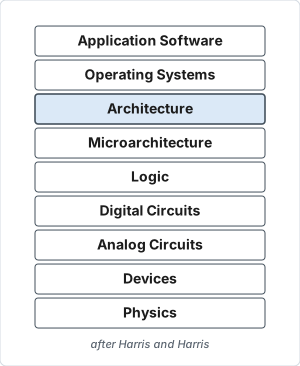
The architecture, or instruction set architecture (ISA), is the contract between hardware and software. It tells a programmer (or a compiler) everything needed to write a correct program, and says nothing about how the hardware achieves it. It specifies:
- the instructions and what each one does;
- where operands can come from: registers, memory, or constants (immediates) embedded in the instruction;
- how each instruction is encoded as a pattern of bits.
A program can be written in two equivalent forms:
- Machine code: the binary encoding that the processor fetches and executes.
- Assembly language: a textual notation for the same instructions, using
mnemonics such as
addand register names such asx5.
An assembler translates assembly language into machine code. Each assembly
instruction normally becomes exactly one machine instruction. The exceptions are
pseudo-instructions, shorthands that the assembler expands into one or more
real instructions. For example, li (load immediate) with a large constant
becomes a lui followed by an addi.
The microarchitecture is a particular hardware design that implements an ISA: its datapath, control unit, pipeline, caches and so on. One ISA can have many microarchitectures. A small single-cycle core and a high-performance out-of-order core can run the same RISC-V binary and produce the same results. They differ only in speed, area and power.
RISC-V history
- Began in 2010 at the University of California, Berkeley as a short project.
- The aim was an ISA that anyone could use freely, whether for teaching, research or commercial products, with no licence fees or royalties.
- Introduced in Aug 2014.
- Transferred to the RISC-V Foundation in 2015, and then on to RISC-V International, a Swiss non-profit entity, in November 2019.
- Fast gaining traction — numerous open source as well as commercial implementations.
- Software support improving fast.
Notable products and software
- ESP32-C3, ESP32-C6. ESP32-S series also have ultra-low-power cores which are RISC-V based, though the main processors are Xtensa based.
- Raspberry Pi Pico 2, Microchip FPGAs/SoCs.
- Modern Nvidia GPUs and large processor chips include dozens of embedded NV-RISCV management cores.
- Many implementations and commercial products — see the list on Wikipedia.
- Many hardware accelerators built around RISC-V cores.
- Mainline support for RISC-V ISA was added to the Linux kernel in 2022.
- In July 2023, RISC-V, in its 64-bit variant called
riscv64, was included as an official architecture by Debian.
RISC-V features
- As a RISC architecture, the RISC-V ISA is a load–store architecture — only
load/store variants can access memory.
- No mixing of memory access with data processing or branching.
- Interesting design choices to simplify hardware implementation.
- Especially the encoding of immediates.
- Modular design — the instruction set is designed for a wide range of uses.
- Every instruction in the base set is 32 bits long and stored at an address that is a multiple of 4. There are a few base variants, such as RV32I, RV32E and RV64I.
- Extensions may add instructions of other lengths, as long as each length is a multiple of 16 bits.
- Extensions include multiplication (M), floating point (F, D, Q), atomics (A), compressed instructions (C — 16-bit long instructions for high code density like ARM Thumb), …
Note
Instruction lengths and word lengths are not necessarily the same.
RISC-V base instructions
To process data.
- register:
add,sub,or,xor,and,sll,srl,sra,slt,sltu - immediate:
addi,ori,xori,andi,slli,srli,srai,slti,sltiu - upper immediate:
lui(load upper immediate),auipc(add upper immediate to pc)
To access memory.
- offset mode:
lw,lh,lb,lhu,lbu,sw,sh,sb - No data processing. No pre/post index addressing.
To change control flow.
- Branch (conditional, no link):
beq,bne,blt,bge,bltu,bgeu - Jump (unconditional, with link):
jal,jalr
Special purpose instructions.
ecall(system call),ebreak(breakpoint),fence(memory barrier)