Registers
The register file
- There are 32 integer registers (
x0–x31).- Unlike ARM, which has 16 registers.
- This means that each register needs a 5-bit identifier.
- This is 4-bit for ARM.
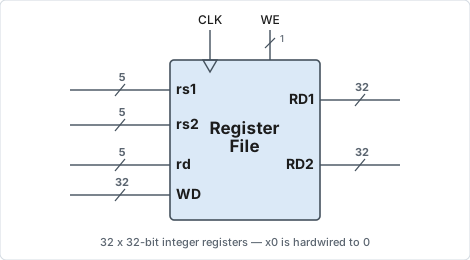
- There are also 32 floating-point extension registers if supporting floating point; as well as control and status registers (most not accessible in user mode).
Calling convention (ABI)
The description below is the typical use (part of the calling convention / ABI) for each register.
| Register | ABI Name | Description | Saver |
|---|---|---|---|
x0 |
zero |
Zero constant | — |
x1 |
ra |
Return address | Caller |
x2 |
sp |
Stack pointer | Callee |
x3 |
gp |
Global pointer | — |
x4 |
tp |
Thread pointer | — |
x5–x7 |
t0–t2 |
Temporaries | Caller |
x8 |
s0 / fp |
Saved / frame pointer | Callee |
x9 |
s1 |
Saved register | Callee |
x10–x11 |
a0–a1 |
Fn args/return values | Caller |
x12–x17 |
a2–a7 |
Fn args | Caller |
x18–x27 |
s2–s11 |
Saved registers | Callee |
x28–x31 |
t3–t6 |
Temporaries | Caller |
x0 and the PC
- Register
x0is hardwired to 0. Writes tox0are ignored.- Allows for easy comparison with 0.
- The equivalent of MOV is implemented using
addition with
x0, etc.
- PC is not a register readable/writable explicitly by any instruction, i.e.
it is not a visible register.
- Unlike ARM, where PC can be specified as an operand (
R15).
- Unlike ARM, where PC can be specified as an operand (
- Reading from PC can be done indirectly through
auipc,jal, and branch instructions, which use PC itself as an operand.- And not PC+8 like in ARMv3 or PC+4 like in ARMv7M / Thumb2.
- Writing PC is done only by branch/jump instructions.
Register reads and writes
One write port, two read ports
These two constraints shape a surprising amount of the rest of the ISA.
- No instruction updates more than one visible register, and the register
updated is explicitly specified in the
rdfield.- This is unlike ARM, where some instructions such as
BL update a visible register (
R14/LR) implicitly, i.e. without 14 explicitly specified in the instruction. - This ensures that the register file needs only one write port.
- This has some implications such as not having pre/post-indexed addressing, multiply/division not giving 64-bit results, etc. (discussed later).
- This is unlike ARM, where some instructions such as
BL update a visible register (
- No instruction reads more than two registers. The register file needs only
2 read ports.
- This implies that instructions such as MLA (multiply and accumulate) are not possible.
Flag registers
- There is no flag register(s) — flags are generated and used in the same instruction and not memorized for future use.1
- It was designed this way to minimize interaction between instructions.
- Only branch instructions are conditional, based on the result of a comparison
done by the instruction itself — CMP +
BEQ of ARM is replaced by
beq. - This also means the branch target computation cannot be done in the ALU, as the ALU does the comparison.
-
If the result of a comparison is needed for future use other than branching, an instruction such as
sltis used. It writes the result to a general-purpose register rather than to a dedicated flag register/flip-flop. ↩