Instruction Formats
Comparison with ARM
This is different from ARM, which has basically 3 formats: one for each category — DP (which has 3 sub-variants: DP Imm, DP reg shifted imm, DP reg shifter reg), Memory, and Branch.
The six base formats
- R (register: DP register)
- I (immediate: DP immediate, load —
lw,jalr) - S (store:
sw) - B, also referred to as SB (short branch:
beq,bne,bge,blt,bgeu,bltu) - U (upper:
lui,auipc) - J, also referred to as UJ (upper jump:
jal)
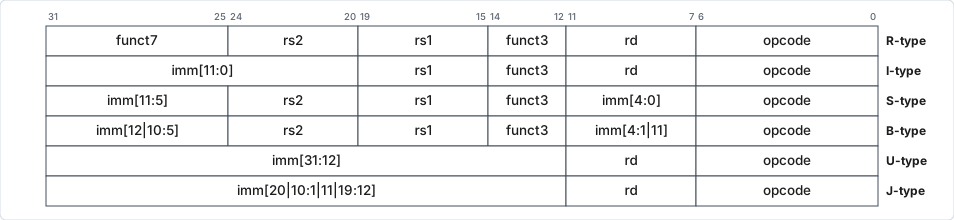
- The opcode field occupies the least significant part of the instruction,
and RISC-V uses a little-endian format.
- This allows for the instruction type to be determined just by looking at the first byte alone (which occupies the lower memory address in little-endian).
rs1,rs2, andrdbit positions are standardized across formats.- Saves some multiplexers.
Immediates
- All immediates are MSB-extended — this implies sign-extension in almost
all cases (but is a bit non-intuitive for
sltu, where an unsigned number like0xFFFFFFF8is encoded as an immediate0xFF8).
Syntax
Immediates in RISC-V assembly are not written with a # sign in front,
unlike ARM.
Partial Verilog code for the Extend unit illustrates the commonalities that allow for hardware simplicity — saves muxes:
ExtImm <= { Instr[31:20], Instr[19:12], 11'h000, 1'b0} ;                                    // U
ExtImm <= {{12{Instr[31]}}, Instr[19:12], Instr[20], Instr[30:25], Instr[24:21], 1'b0} ;    // J
ExtImm <= {{20{Instr[31]}}, Instr[31], Instr[30:25], Instr[24:21], Instr[20]} ;             // I
ExtImm <= {{20{Instr[31]}}, Instr[31], Instr[30:25], Instr[11:8],  Instr[7]} ;              // S
ExtImm <= {{20{Instr[31]}}, Instr[7],  Instr[30:25], Instr[11:8],  1'b0} ;                  // B
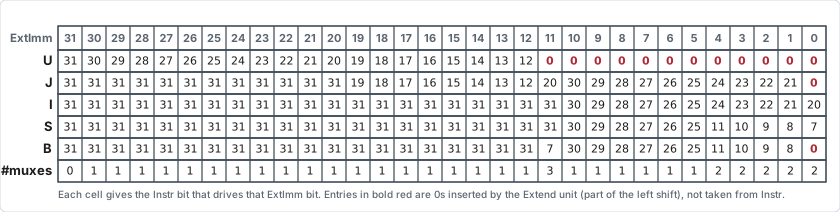
Instr bit drives each ExtImm bit, and the number of muxes that results.Note
Those shown in bold (red) are 0s inserted by the Extend unit (as a part of a
left shift), not coming directly from Instr bits.